
Eligibility Criteria for Surrogacy in India (2026)
Surrogacy in India is not a free-choice medical option anymore. After the Surrogacy (Regulation) Act, 2021 and Surrogacy (Regulation) Rules, 2022, the system has become strict, document-heavy, and controlled by government boards.
This article explains who is allowed, who is not allowed, and why the law is designed this way, using actual government rules not assumptions.
1. First Understanding: What Type of Surrogacy is Allowed?
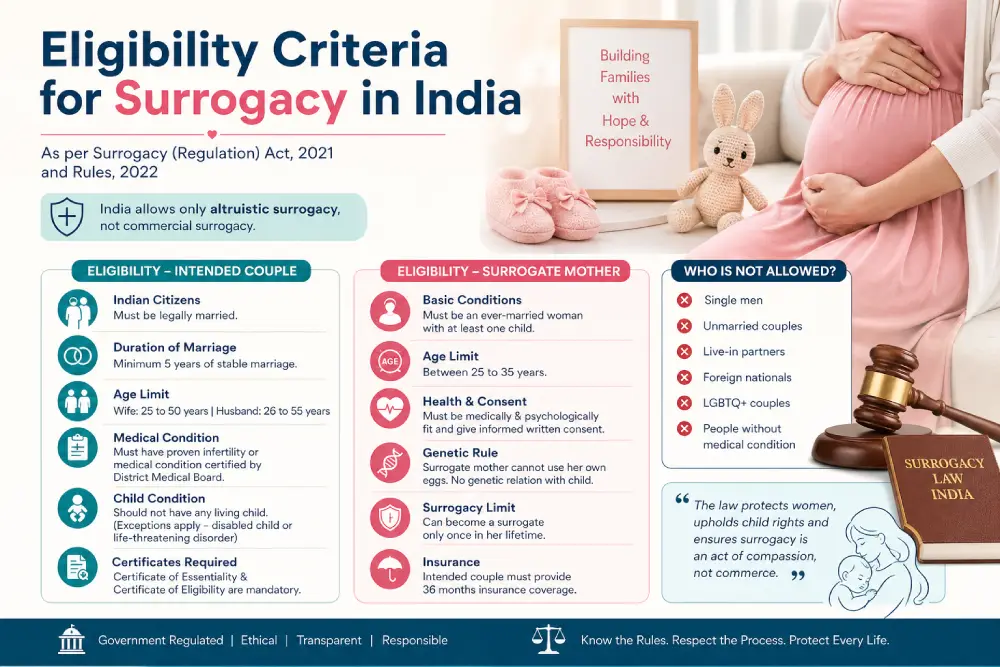
India allows only altruistic surrogacy.
That means:
- No payment to surrogate mother (except medical + insurance costs)
- No business or commercial deals allowed
- No “renting womb” model
This is clearly done to stop exploitation of poor women, which was a big issue earlier.
Strong point: The law is not just medical it is social protection law.
2. Eligibility Criteria for Intended Couple (Parents)
(A) Citizenship & Marriage Condition
- Must be Indian citizens
- Must be legally married
- Marriage duration: Minimum 5 years
This removes live-in couples, foreign nationals, and casual arrangements.
(B) Age Limit (Very Strict)
- Wife: 25 to 50 years
- Husband: 26 to 55 years
Courts have already seen cases where people were rejected just for crossing age by few months.
(C) Medical Condition is Mandatory
You cannot choose surrogacy just because you want it.
You need:
- Proven infertility OR
- Serious medical condition (certified by District Medical Board)
Without medical reason → Not allowed
This is one of the strictest rules in the world.
(D) Child Condition Rule
- Couple should not have any living child
Exception:
- If existing child is:
- Mentally challenged OR
- Physically disabled OR
- Has life-threatening disorder
This shows law is focused on “need”, not “choice”.
(E) Certificates Required (Most Important Part)
Before surrogacy, couple must obtain:
- Certificate of Essentiality
- Infertility proof
- Court order for parentage
- Insurance for surrogate
- Certificate of Eligibility
- Age proof
- Marriage proof
- No child declaration
Without these, process cannot even start.
3. Eligibility Criteria for Surrogate Mother
This is where law becomes even more strict.
(A) Basic Conditions
- Must be ever-married woman
- Must be Known/Relative of Intended Parents
- Must have at least one child of her own
- Age: 25 to 35 years
(B) Medical & Psychological Fitness
- Must be declared fit by medical authority
- Must give written informed consent
(C) Surrogacy Limit
- Can become surrogate only once in lifetime
This rule is to protect women from repeated physical stress.
(D) Genetic Rule (Very Important)
- Surrogate mother cannot use her own eggs
- She must not be genetically related to the child
This ensures she is only a carrier, not biological mother.
(E) Insurance Requirement
- Intended couple must provide 36 months insurance cover
- Covers:
- Pregnancy complications
- Post-delivery risks
This is one of the most practical protections in law.
4. Who is NOT Allowed for Surrogacy in India?
This is where many people misunderstand the law.
❌ Single men – Not allowed
❌ Unmarried couples – Not allowed
❌ Live-in partners – Not allowed
❌ Foreigners (in most cases) – Not allowed
❌ LGBTQ+ couples – Not included in current law
❌ People without medical condition – Not allowed
Even single women are allowed only in specific cases (widow/divorcee with conditions).
5. Hidden Reality: Law vs Ground Situation (Original Insight)
On paper, rules look protective. But in real life:
- Process is very long and bureaucratic
- Multiple approvals needed (medical board + legal + registration)
- Clinics are strictly monitored
- No financial incentive → finding surrogate is difficult
There are also concerns that:
- Too strict rules may push people toward illegal methods
- Genuine couples suffer due to documentation delays
Recent court cases show flexibility sometimes, especially in age-related situations.
So, the law is protective but not always practical.
6. Ethical Thinking Behind the Law
The law is built on three core ideas:
- No commercialization of motherhood
- Protection of women’s body
- Child rights first
But it also raises questions:
- Why exclude single men?
- Why no option for modern families?
- Why so much control over personal decisions?
This is where law meets society and conflict starts.
7. Step-by-Step Summary
- Medical reason confirmed
- Apply to District Medical Board
- Get eligibility + essentiality certificates
- Find eligible surrogate
- Insurance + consent completed
- Register clinic + legal approval
- Proceed with IVF and surrogacy
FAQ’s about Surrogacy in India
Q1. Can anyone choose surrogacy in India?
No. Only those with medical necessity approved by the government board can opt for it.
Q2. Is commercial surrogacy allowed in India?
No. Only altruistic surrogacy is legal. Payment beyond medical expenses is banned.
Q3. Can a single man apply for surrogacy?
No. Single men are completely excluded under current law.
Q4. How many times can a woman become a surrogate?
Only once in her lifetime, to protect her health.
Q5. Is the age limit strictly followed?
Yes. Even small deviations can lead to rejection, though courts sometimes give relief in rare cases.
