
Choosing the right surrogacy centre in Delhi is one of the most important decisions for intended parents. Surrogacy is not just a medical treatment—it is a long legal, emotional, and medical journey that requires experienced fertility specialists, transparent counselling, ethical practices, and proper patient support.
Delhi has become one of India’s leading destinations for advanced fertility treatments because it has experienced IVF specialists, modern embryology laboratories, multispecialty hospitals, and comprehensive infertility care. However, after the implementation of the Surrogacy (Regulation) Act, commercial surrogacy is no longer permitted in India. Only altruistic surrogacy is allowed under specific legal conditions.
This means that choosing a clinic today is no longer about finding the lowest cost. It is about selecting a centre that follows Indian laws, provides ethical medical guidance, has experienced reproductive specialists, and offers transparent counselling throughout the process.
This guide compares some of the most recognised surrogacy and fertility centres in Delhi based on publicly available information, patient feedback, infrastructure, medical expertise, fertility services, and overall reputation.
What is Altruistic Surrogacy? Understanding the Law in Delhi
Since the Surrogacy (Regulation) Act, 2021 and the Assisted Reproductive Technology (Regulation) Act, 2021 came into force, commercial surrogacy has been banned everywhere in India, including Delhi. Only altruistic surrogacy is legal now.
In altruistic surrogacy, the surrogate mother is not paid a fee for carrying the child. She can only be reimbursed for medical expenses, insurance coverage, and other costs directly related to the pregnancy nothing beyond that. This is a deliberate policy shift by the Indian government to stop the commercial surrogacy industry that grew rapidly in India between roughly 2005 and 2015, when the country was informally called the “surrogacy capital of the world.” That industry raised serious ethical concerns about exploitation of poor women, unclear legal parentage, and lack of medical safeguards, which is exactly why the 2021 laws were brought in.
For altruistic surrogacy in Delhi, a few conditions matter a lot:
- The surrogate must be a close relative of the intending couple, married, having a child of her own, and between 25 and 35 years of age. She can act as a surrogate only once in her lifetime.
- The intending couple must be legally married Indian citizens (heterosexual couples only, under current law), with the wife aged 23–50 and husband 26–55, and must not have any surviving biological, adopted, or surrogate child already except in cases involving mentally or physically challenged children, or specific medically certified conditions.
- A District Medical Board must issue an eligibility certificate confirming infertility or medical necessity for surrogacy.
- The couple needs a certificate of essentiality and a certificate of eligibility from the appropriate authority before starting the process this is issued at the state level, and in Delhi this authority sits under the Directorate of Health Services.
- The clinic itself must be registered under the National Assisted Reproductive Technology and Surrogacy Registry (NARS), which every legitimate surrogacy centre in Delhi is required to be part of.
Since the surrogate cannot be paid, foreign nationals, OCI card holders, NRIs, unmarried individuals, and same-sex couples are currently not eligible for surrogacy in India under this law this is a significant point that many clinic websites gloss over, so if a centre tells you otherwise, that itself is a warning sign.
For genuine intending parents, this means the process is slower and more paperwork-heavy than it was a decade ago, but it is also safer, more transparent, and legally far more secure for both the child and the surrogate.
List of Top 10 Best Surrogacy Centre in Delhi (2026)
- KIC Delfinium Fertility
- Birla Fertility & IVF
- Fertilityworld
- Gaudium IVF and Women Health Limited
- Indira IVF
- Invitro Baby Fertility Centre
- Kiran Infertility Centre (KIC), New Delhi — Kailash Colony
- Mediworld Fertility Centre
- Baby Grow Fertility Centre
- International Fertility Centre (IFC)
Quick Comparison of Top Surrogacy Centres in Delhi
| Clinic | Overall Rating | Best For | Estimated Cost* |
| KIC Delfinium Fertility | 4.9/5 | Comprehensive fertility care & personalised treatment | Consultation Based |
| Birla Fertility & IVF | 4.8/5 | Large IVF network | Consultation Based |
| Fertilityworld | 4.8/5 | Advanced IVF laboratory | Consultation Based |
| Gaudium IVF and Women Health Limited | 4.7/5 | High-risk fertility cases | Consultation Based |
| Indira IVF | 4.7/5 | Modern reproductive medicine | Consultation Based |
| Invitro Baby Fertility Centre | 4.6/5 | Individualised fertility treatment | Consultation Based |
| Kiran Infertility Centre (KIC), New Delhi — Kailash Colony | 4.6/5 | Female infertility treatment | Consultation Based |
| Mediworld Fertility Centre | 4.5/5 | IVF and fertility preservation | Consultation Based |
| Baby Grow Fertility Centre | 4.5/5 | International patients | Consultation Based |
| International Fertility Centre | 4.5/5 | Multispecialty hospital support | Consultation Based |
*Costs vary depending on individual medical conditions, investigations, IVF requirements, medications, and legal procedures. Always obtain a written estimate from the clinic.
List of 10 Best Surrogacy Clinics Operating in Delhi (Real Names, No Invented Ratings)
Before this list, one honest disclosure: this is not a ranked “best to worst” list. I have not personally audited these clinics’ embryology labs, cross-checked their NARS registration numbers, or verified their claimed success rates against independent data and neither has almost any other website telling you a specific clinic is “#1.” So instead of inventing a rank order, here are ten real, currently operating clinics in Delhi with fertility/surrogacy services, listed alphabetically, along with what is publicly available about each clearly marked as either verified contact details or the clinic’s own claim.
Use this as your starting shortlist, then apply the “How to Choose” checklist further down to actually narrow it down for your own case.
-
KIC Delfinium Fertility Centre
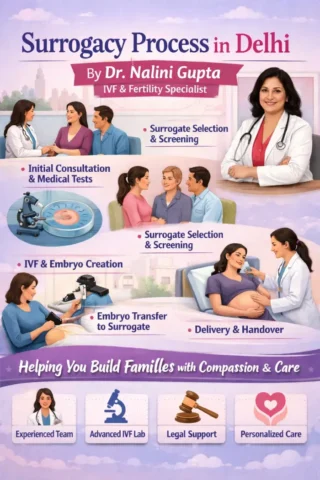
KIC Delfinium is a South Extension clinic led by Dr. Nalini Gupta, operating as a joint venture with the Hyderabad-based Kiran Infertility Centre (KIC) group founded by Dr. Samit Sekhar, which also has branches in Bengaluru and Chennai. The centre markets itself specifically around altruistic surrogacy compliance and states it provides in-house legal assistance for the government certification process, medical visa help for international patients, and video consultation options with senior doctors. Given that legal paperwork is one of the most commonly cited bottlenecks in Delhi surrogacy cases, a clinic that puts genuine resources into an in-house legal desk is worth evaluating on that basis specifically ask to see how many altruistic surrogacy (not just IVF) cases they’ve taken through District Medical Board certification, and in what timeframe.
- Address: F-21, South Extension I, Block F, New Delhi 110049 (near McDonald’s, South Extension 1)
- Phone: +91 9599754411
- Email: info@kicdelfinium.com
- Website: kicdelfinium.com
Strengths worth noting: Dedicated altruistic-surrogacy legal support messaging, affiliation with a longer-established South Indian fertility group, multiple published contact numbers and a working email address, international-patient support infrastructure. Points to verify yourself: Actual number of altruistic surrogacy cases completed since the 2021 law (not total IVF cases); independent verification of the “40 years combined experience” claim; current NARS registration number for the Delhi branch specifically.
-
Birla Fertility & IVF
Birla Fertility & IVF is a large, multi-city fertility chain that entered the Delhi market as part of a national expansion and now runs several branches across the capital, including Lajpat Nagar, Dwarka, and Rohini. The chain positions itself among India’s top three fertility groups and states it has completed over 1,20,000 IVF cycles nationally, supporting more than a million patients, with a self-reported patient satisfaction figure of around 95%. It offers IVF, IUI, ICSI, egg freezing, donor programs, and treatment for conditions like PCOD, low AMH, and tubal blockage, alongside 0% EMI payment options. Because it operates as a chain, service quality and doctor experience can vary noticeably from one Delhi branch to another, so it’s worth confirming which specific centre and doctor you will actually be treated by before booking, rather than assuming the group-level statistics apply uniformly to every branch.
- Address (Lajpat Nagar): Plot No. 63, 1st & 2nd Floor, Ring Road, Near Haldiram’s, Lajpat Nagar III, New Delhi 110024
- Address (Dwarka): 2nd Floor, Plot No. 18, Wadhwa Plaza III, Sector-10, Dwarka, New Delhi 110075
- Contact: Available via the branch-specific enquiry numbers listed on their website
- Website: birlafertility.com
Strengths worth noting: Large multi-branch presence across Delhi, NABH-accredited facilities at some branches, 0% EMI payment plans, structured chain-level processes. Points to verify yourself: Which specific doctor and lab you’ll be assigned at your chosen branch; whether the group-level success statistics reflect that specific branch’s actual case mix and patient age profile; current NARS registration status for the exact branch.
-
Fertilityworld
Fertilityworld describes itself as a fertility chain with centres in Green Park, Dwarka, Greater Kailash, Rohini, and Saket, offering IVF, ICSI, IUI, frozen embryo transfer, and both self- and donor-assisted surrogacy programs. Its process begins with a free first consultation and medical report review, followed by a legal agreement drafted with the help of an in-house attorney once a couple decides to proceed with surrogacy. The clinic states it was established roughly 25 years ago, though this claim, like most “years in operation” figures on clinic websites, is worth cross-checking against independent business registration records rather than taken at face value.
- Address: Operates multiple Delhi locations (Green Park, Dwarka, Greater Kailash, Rohini, Saket) confirm your nearest branch address directly, as the group markets itself under one umbrella brand
- Phone: +91 93118 50412
- Email: info@fertilityworld.in (customer care: support@fertilityworld.in)
- Website: fertilityworld.in
Strengths worth noting: Multiple Delhi locations for convenience, free first consultation, states an in-house legal attorney for surrogacy agreements. Points to verify yourself: Independent confirmation of the “25 years” operating history; which exact branch and lab will handle your embryology work; current NARS registration number.
-
Gaudium IVF and Women Health Limited
Founded in 2009 by Dr. Manika Khanna, Gaudium IVF has grown into a large chain with over 25 centres across multiple Indian states, including several branches in Delhi (Janakpuri, Kailash Colony, and Greater Kailash Part-1). The group states it was recognised as the Best IVF Centre in Delhi by a Times of India health survey and highlights affordable pricing with EMI options as a core part of its positioning. As with most chains carrying “Rank No. 1” language on their own website, this should be treated as marketing copy rather than independently audited fact until you’ve verified the specific claim and its source.
- Address (Janakpuri): 51, Block B1, Janakpuri East, New Delhi 110058
- Address (Kailash Colony): A-19, Ground Floor, Kailash Colony, near Kailash Colony Metro Station, South Delhi 110048
- Address (Greater Kailash-1): R-21, First Floor, Greater Kailash Part-1, New Delhi 110048
- Phone: +91 85278 58585 / 011-48 85 85 85
- Email: info@gaudiumivfcentre.com
- Website: gaudiumivfcentre.com
Strengths worth noting: Multiple Delhi branches, founder with a long publicly documented medical career, EMI payment options, consistent contact details across sources. Points to verify yourself: The exact basis and date of the “Best IVF Centre” survey claim; whether the doctor you consult is Dr. Khanna herself or another specialist at that branch; current NARS/surrogacy registration for the branch you choose.
-
Indira IVF
Indira IVF is one of India’s largest fertility chains, founded in 1988 by Dr. Ajay Murdia, with over 200 centres nationally and several branches across Delhi, including Patel Nagar, Lajpat Nagar, and Shahdara. The chain states it has supported over 2,00,000 successful pregnancies and reports that cumulative success rates “can exceed 70%” an important detail here is that this is a chain-wide cumulative figure, not a per-cycle or age-adjusted number specific to any one Delhi branch, so ask directly what the equivalent figure looks like for patients in your own age bracket and diagnosis at your specific branch.
- Address (Patel Nagar): 1/14, Metro Station, opposite Metro Pillar No. 199, Block 1, West Patel Nagar, New Delhi 110008
- Toll-free: 1800-309-2323
- Website: indiraivf.com
Strengths worth noting: Large national scale with standardised protocols, multiple accessible Delhi locations, transparent published toll-free contact line, budget-friendly EMI plans. Points to verify yourself: Age- and diagnosis-specific success data (not just the chain-wide cumulative number); which of the several Delhi branches offers full surrogacy support versus IVF only; current NARS registration for your chosen branch.
-
Invitro Baby Fertility Centre
Invitro Baby is a Greater Kailash-based clinic led by Dr. Tara/Thara Fotedar, offering IVF, IUI, ICSI, IVM, PGS, and surrogacy support, along with virtual consultation options for patients unable to visit in person. The clinic publishes a self-reported “65% success rate” on its own site a figure worth asking about directly, since success rates in fertility care are almost always reported differently depending on whether they’re measured per cycle, per embryo transfer, or cumulatively across multiple attempts, and the clinic’s own marketing rarely specifies which. The centre states it follows the ART (Regulation) Act, 2021 in its surrogacy program.
- Address: C-50, 2nd Floor, Greater Kailash-1 (Block C), near Bhole Sai Temple, Hansraj Gupta Road, New Delhi 110048
- Phone: +91 8851480794 (also listed: 08460542052)
- Website: invitrobaby.in
Strengths worth noting: Single fixed location (easier to verify than a multi-branch chain), virtual consultation option for out-of-town patients, states explicit compliance with the ART Act 2021. Points to verify yourself: The exact methodology behind the published 65% success figure; current NARS registration; whether their in-house legal support extends to the full altruistic surrogacy certification process or only to IVF/ICSI paperwork.
-
Kiran Infertility Centre (KIC), New Delhi Kailash Colony
This is the separate Delhi branch of the same Kiran Infertility Centre group (a sister concern to KIC Delfinium above), located in Kailash Colony rather than South Extension. Because both centres share the KIC name and group affiliation but operate as distinct physical clinics with potentially different doctors and pricing, it’s worth calling both branches directly and comparing what each offers before assuming they are interchangeable.
- Location: Kailash Colony, New Delhi (confirm exact branch address and consultant on enquiry, as the group’s Delhi presence is listed under both the KIC and KIC Delfinium names)
- Group website: kiranfertility.com
Strengths worth noting: Backed by a fertility group with three decades of stated experience across Hyderabad, Bengaluru, and Chennai; part of a network serving international patients from multiple countries. Points to verify yourself: Exact current address and lead doctor for this specific Kailash Colony branch; how its pricing and services differ from the South Extension KIC Delfinium branch; NARS registration for this branch independently of its sister centre.
-
Mediworld Fertility Centre
Mediworld, operating as a unit of Ditvi Healthcare Pvt. Ltd., positions itself as the first IVF clinic in India to offer integrated counselling alongside medical treatment, with services spanning IVF, IUI, ICSI, IMSI, donor programs, laparoscopy, high-risk pregnancy management, and end-to-end surrogacy support. It publishes some of the highest self-reported success figures among Delhi clinics over 96% pregnancy success and 87% successful surrogacy outcomes across more than 1,250 families figures that, like all clinic-published statistics, deserve a direct follow-up question about methodology (per cycle vs. cumulative, and over what time period) before you rely on them for your own decision-making.
- Address (Safdarjung Enclave): Aashlok Hospital, 25-AB, Safdarjung Enclave, New Delhi 110029
- Address (Sukhdev Vihar): 201, LG Floor, Sukhdev Vihar, New Delhi 110025
- Phone: +91 9315615376 (24/7 general enquiry line)
- Email: info@mediworldfertility.com
- Website: mediworldfertility.com
Strengths worth noting: Two accessible Delhi locations, integrated counselling built into the treatment process rather than offered separately, specific published surrogacy success figure (rare among competitors, though still self-reported), a 24/7 general enquiry contact line. Points to verify yourself: The exact patient cohort and time period behind the 87% surrogacy and 96% pregnancy figures; current NARS registration; whether “end-to-end surrogacy services” includes the full District Medical Board certification support or requires an external lawyer.
-
Baby Grow Fertility Centre
Baby Grow Fertility publishes a large volume of educational content specifically about India’s altruistic surrogacy framework and markets itself across several cities, including Delhi, Bihar, and Kolkata. Unlike most of the other centres on this list, its published Delhi contact information is limited to a phone number and a general “New Delhi – 110001” listing rather than a specific street address this is worth asking about directly and confirming in writing before you commit any documentation or payment, since a fully transparent clinic should be able to give you a physical consultation address without difficulty.
- Location: New Delhi – 110001 (request the specific street address and physical clinic location directly, as it is not published in detail on their public contact page)
- Phone: +91 98217 57971
- Website: babygrowfertility.com
Strengths worth noting: Detailed public-facing educational content on India’s surrogacy law, multi-city presence, responsive phone/WhatsApp contact listed. Points to verify yourself: A specific, verifiable street address for the Delhi centre; the identity and qualifications of the treating doctor and embryology lab used; current NARS registration number, since none is prominently published on their site.
-
International Fertility Centre
International Fertility Centre (IFC) is one of the well-known fertility clinics in Delhi, offering a wide range of assisted reproductive treatments for couples facing infertility challenges. Established with the aim of providing advanced fertility care, the centre offers services such as IVF (In Vitro Fertilization), ICSI, IUI, Altruistic Surrogacy, egg freezing, fertility preservation, donor programs where legally permitted, and comprehensive infertility evaluation for both men and women. The clinic is equipped with modern IVF laboratories and follows internationally accepted fertility treatment protocols to improve clinical outcomes while maintaining patient safety.
- Address: H-6, Green Park (Main) New Delhi -110016 India
- Phone: +91-11-40666680 / 40666681
- Email: doctor@risaaivf.com
- Website: internationalfertilitycentre.com
Strengths worth noting: Transparent published address and working contact details, useful public guidance on accreditation checks, wide network across multiple cities and countries for patients considering options beyond Delhi. Points to verify yourself: Whether they are the actual treating facility or a referral/facilitation service directing you to a partner hospital; the specific partner clinic’s own NARS registration and legal-support capability; total combined costs once facilitation fees are added to the partner clinic’s own package price.
A repeated theme above is deliberate. Nearly every clinic on this list publishes an impressive self-reported success percentage, and nearly none of them specify exactly what that percentage measures. This isn’t necessarily dishonesty fertility statistics genuinely are complex, and “success” can fairly be measured multiple ways but it does mean the number alone should never be your deciding factor. The single most useful question you can ask any clinic on this list is: “What percentage of your altruistic surrogacy cases (not IVF cases generally) in the last two years resulted in a live birth, and how many total altruistic surrogacy cases is that based on?” A clinic that answers this specifically and confidently has usually earned your attention; one that redirects to a vague headline number has not.
Why isn’t this list ranked, and why doesn’t one clinic appear “on top”? Because an honest ranking would need independently verified, audited success-rate data broken down by patient age and procedure type, third-party-verified reviews, and confirmed current NARS registration for each centre data that isn’t publicly available for any of these clinics in a comparable format. Any article that gives you a clean 1-to-10 rank with star ratings for all of these is almost certainly presenting marketing copy (often written by the clinics themselves) as independent research. Call each of your shortlisted clinics, ask the direct questions listed below, and build your own comparison using the table template.
How to Find and Shortlist Surrogacy Centres in Delhi?
Rather than trusting a ready-made “top 10” list from a random blog, here is how a well-informed patient actually shortlists a centre:
- Check NARS registration. Every legal ART/surrogacy clinic in India must be registered on the National Registry. You can verify a clinic’s registration status directly rather than taking their word for it.
- Check for an in-house or empanelled legal team. Since surrogacy in Delhi involves multiple government certificates and a legal surrogacy agreement, a serious clinic will have lawyers who handle this, not just doctors.
- Ask for real patient references, not testimonials printed on the website. A clinic confident in its outcomes will connect you (with consent) to a past patient.
- Visit the embryology lab in person if possible. IVF and surrogacy success depends heavily on lab quality, not just the doctor’s reputation.
- Ask specifically about the District Medical Board certification process how many cases they’ve taken through it, and how long it typically takes at their centre.
- Compare multiple centres before committing. Get at least three consultations. A centre that pressures you to sign up on the first visit is not one you should trust with a multi-year medical and legal process.
What to Actually Ask Each Clinic (Instead of Trusting a Star Rating)?
When you visit or call a shortlisted clinic in Delhi, these are the questions that reveal more than any star rating:
- How many altruistic surrogacy cases (not just IVF cases) have you completed since the 2021 law came into effect?
- Who handles the legal agreement and government certificates an in-house team or an outsourced lawyer?
- What is included and excluded in your quoted package medical procedures, surrogate’s medical reimbursement, legal fees, embryo storage, and delivery costs?
- What happens if the first embryo transfer fails? Is there a revised cost structure?
- Can I speak to a patient who has completed the process at this centre?
- Is the embryology lab on-site, and can I see it?
A centre that answers these clearly and specifically, without vague reassurances, is generally more trustworthy than one that simply quotes a “success rate” percentage with no source.
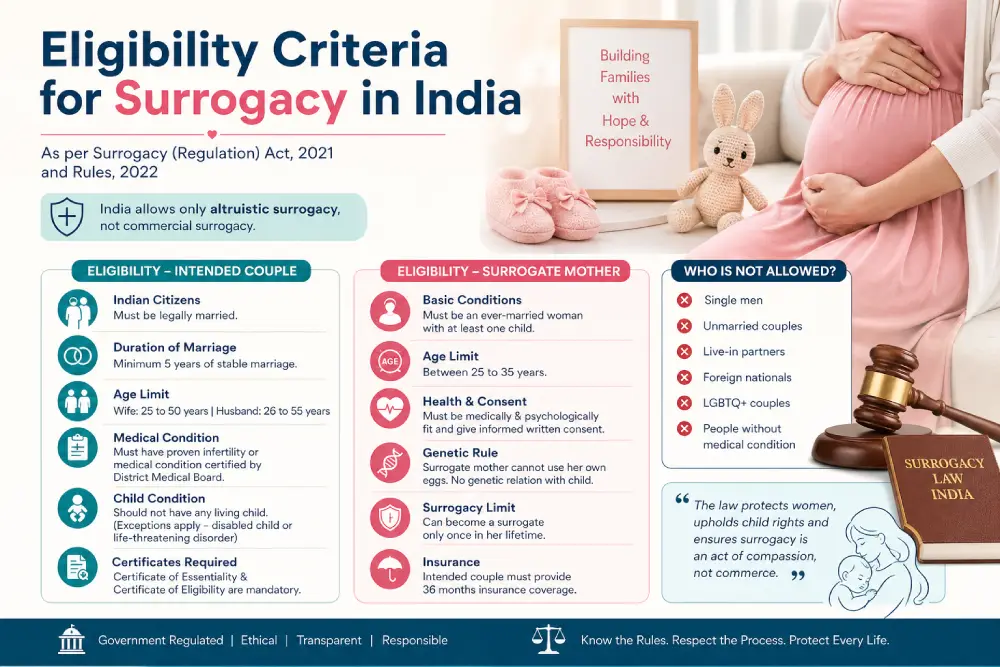
Who is Eligible for Surrogacy in Delhi?
To summarise the eligibility rules under current Indian surrogacy law:
- Intending couple: Legally married Indian heterosexual couple; wife aged 23–50, husband aged 26–55; medically certified infertility or a condition requiring surrogacy; no surviving child (with specific medical exceptions); certificate of essentiality and eligibility from the appropriate authority.
- Surrogate: A close relative of the intending couple; married with a child of her own; aged 25–35; medically and psychologically certified as fit; can be a surrogate only once in her life; covered by insurance for 36 months.
- Not currently eligible: Unmarried individuals, live-in couples, same-sex couples, single parents (except widows/divorcees under specific conditions laid out separately in the law), and foreign nationals/OCIs/NRIs, since commercial arrangements are banned and altruistic surrogacy requires a related surrogate who is an Indian citizen.
Laws in this area do get amended, so always verify current eligibility with the clinic’s legal team and, ideally, an independent lawyer, before assuming your situation qualifies.
Things You Need to Know Before Having Surrogacy in Delhi
- It is a multi-year process, not a quick fix. Between medical board certification, legal documentation, finding an eligible surrogate relative, embryo transfer, and pregnancy, the realistic timeline is often 18–30 months.
- You need a surrogate from within your own family. This is the single biggest practical hurdle for most couples, since the law does not allow unrelated or paid surrogates.
- Insurance is mandatory for the surrogate for a minimum period covering pregnancy and post-delivery care check this is genuinely arranged, not just promised.
- Legal parentage documentation matters as much as the medical process. Get a lawyer to review the surrogacy agreement independently, even if the clinic provides one.
- Emotional and psychological counselling is a requirement, not an optional add-on for both the intending parents and the surrogate. A centre that skips this step is cutting corners.
- Costs vary a lot by case complexity. A couple needing only surrogacy (with their own viable embryos) will pay very differently from a couple who also needs egg or sperm donation support, additional embryo transfer attempts, or extended medical management.
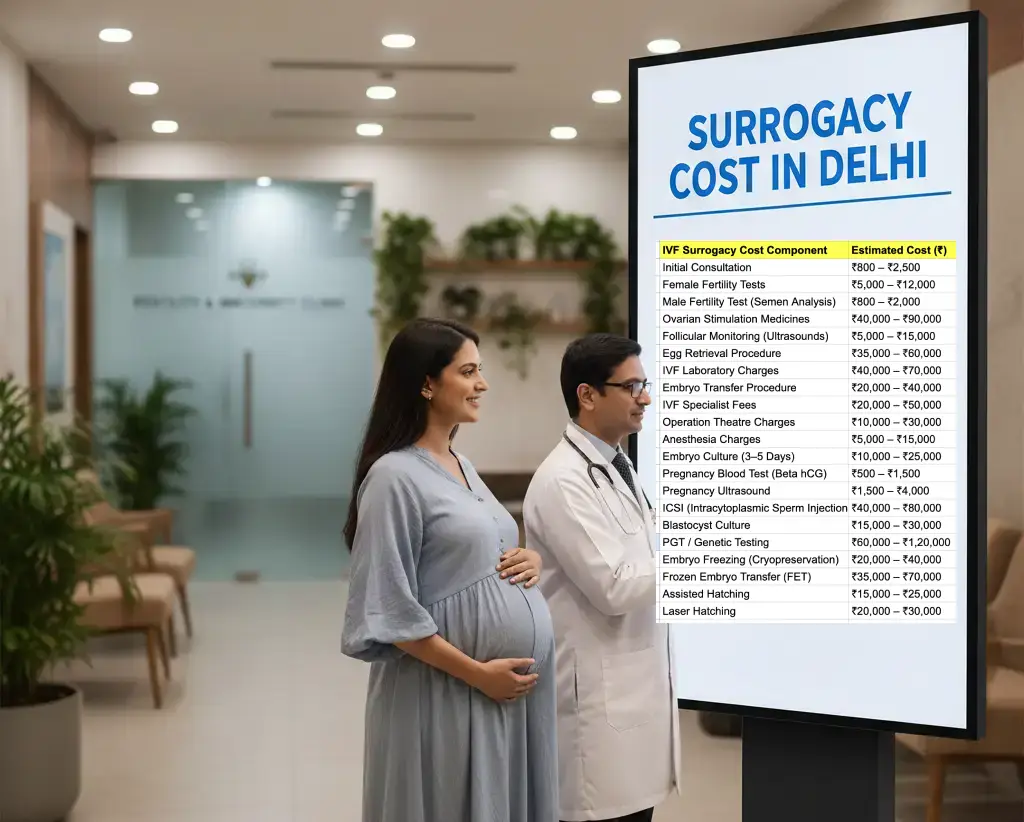
How Much Does Surrogacy Cost in Delhi?
There is no single fixed number, and any website quoting one flat figure for “surrogacy Cost in Delhi” without a breakup is oversimplifying. What follows is a component-wise breakdown built from the ranges commonly published across multiple fertility platforms worth flagging upfront that most of the sources publishing these numbers are fertility clinics themselves marketing their own packages, so treat every figure below as an indicative starting range to verify against your own itemised quote, not a guaranteed price.
Cost Breakdown by Component
| Cost Component | Typical Range (₹) | What It Covers |
| IVF cycle (per attempt) | ₹1,50,000 – ₹3,00,000 | Ovarian stimulation, egg retrieval, fertilisation, and embryo transfer, including medication; may need to be repeated if the first cycle fails |
| Donor gamete cycle (if self-eggs/sperm aren’t viable) | ₹2,00,000 – ₹3,50,000 extra | Additional cost on top of a standard IVF cycle when a donor egg or sperm cycle becomes necessary |
| Surrogate’s medical & pregnancy-related reimbursement | ₹5,00,000 – ₹8,00,000 | Legally, surrogate mothers in India are not paid a fee, but intended parents must cover costs such as her medical care and pregnancy-related expenses this is reimbursement, not compensation, and direct payment beyond this is a criminal offence under the law |
| Surrogate’s mandatory insurance (36-month cover) | ₹50,000 – ₹2,00,000+ | Surrogate insurance covering a 36-month period is now mandatory and protects against pregnancy complications while ensuring legal compliance |
| Legal fees & government documentation | ₹2,00,000 – ₹3,00,000 | Drafting the surrogacy agreement, processing the certificate of essentiality and eligibility, and District Medical Board coordination |
| Delivery, postnatal care & clinic administration | Varies by hospital/case | Delivery costs, NICU care if needed, and the clinic’s coordination/administrative charges |
Total Estimated Cost Range of surrogacy in delhi
Published estimates for the total, all-inclusive cost of a legally compliant altruistic surrogacy vary quite a bit depending on the source and how many components they bundle in:
- One Delhi-specific source puts the combined surrogacy + IVF + documentation package around ₹10,00,000 – ₹20,00,000 for a relatively straightforward case using the couple’s own eggs and sperm, needing only one IVF cycle.
- A broader legal and pricing guide estimates that a legally compliant surrogacy in India commonly runs from around ₹10,00,000 to ₹20,00,000 or more, depending heavily on how many IVF cycles are needed and whether genetic testing is used.
- Some pan-India sources quote a wider and higher range of ₹20,00,000 – ₹35,00,000, generally when factoring in donor gametes, multiple IVF cycles, or complications, and when averaging across more expensive metro markets.
In practical terms: a first-attempt case with the couple’s own eggs and sperm, a cooperative and eligible relative as surrogate, and no complications sits toward the lower end (roughly ₹10–15 lakh). A case needing donor gametes, more than one IVF cycle, or extended medical management can comfortably cross ₹20–25 lakh or more. None of this is a payment to the surrogate herself under the Surrogacy (Regulation) Act, 2021, any direct commercial payment to a surrogate is a criminal offence carrying serious penalties, so every rupee above should map to a genuine medical, legal, or insurance line item that the clinic can itemise for you.
The only reliable way to know your actual cost is to get a written, itemised quotation from each shortlisted clinic after your specific medical case has been reviewed not a number pulled off a comparison website, including this one. Ask every clinic to break their quote down using the same component categories in the table above, so you’re comparing like with like across your shortlist.
Frequently Asked Questions About Surrogacy in Delhi
- Is surrogacy legal in Delhi in 2026?
Yes, but only altruistic surrogacy is legal meaning the surrogate cannot be paid a fee, only reimbursed for medical and related expenses. Commercial surrogacy is banned nationwide under the Surrogacy (Regulation) Act, 2021. - Can a friend or an unrelated woman be a surrogate in Delhi?
No. Under current law, the surrogate must be a close relative of the intending couple. An unrelated surrogate arrangement is not legally permitted. - How long does the surrogacy process take in Delhi, from first consultation to delivery? It typically takes between 18 and 30 months, factoring in medical board approvals, legal certification, embryo preparation, and the pregnancy itself. Delays are common if the first embryo transfer does not succeed.
- Do NRIs or foreign nationals qualify for surrogacy in Delhi? Under the present law, NRIs, OCI cardholders, and foreign nationals are generally not eligible, since the framework requires an Indian citizen relative to act as the altruistic surrogate. Rules can change, so this should always be verified with a lawyer before proceeding.
- How do I verify if a surrogacy centre in Delhi is genuinely registered and legitimate? Ask for their National ART and Surrogacy Registry (NARS) registration number and cross-check it independently, ask how many District Medical Board certifications they have processed, and request to speak to a past patient. Do not rely solely on ratings or testimonials shown on the clinic’s own website.
A Final, Honest Note
If you found this article searching for a ranked “top 10” list with ratings and success percentages already filled in, I’d rather be straightforward with you: any such list you encounter online, unless it clearly cites verifiable sources for those numbers, is most likely invented content written to rank on Google rather than to genuinely help you choose. For a decision this significant involving your family, a relative’s health, and a legal process that shapes your child’s parentage documentation treat every number you see with healthy scepticism, and verify it yourself using the framework and questions above.