
Ovarian PRP in India | Complete Cost & Process Guide (2026)
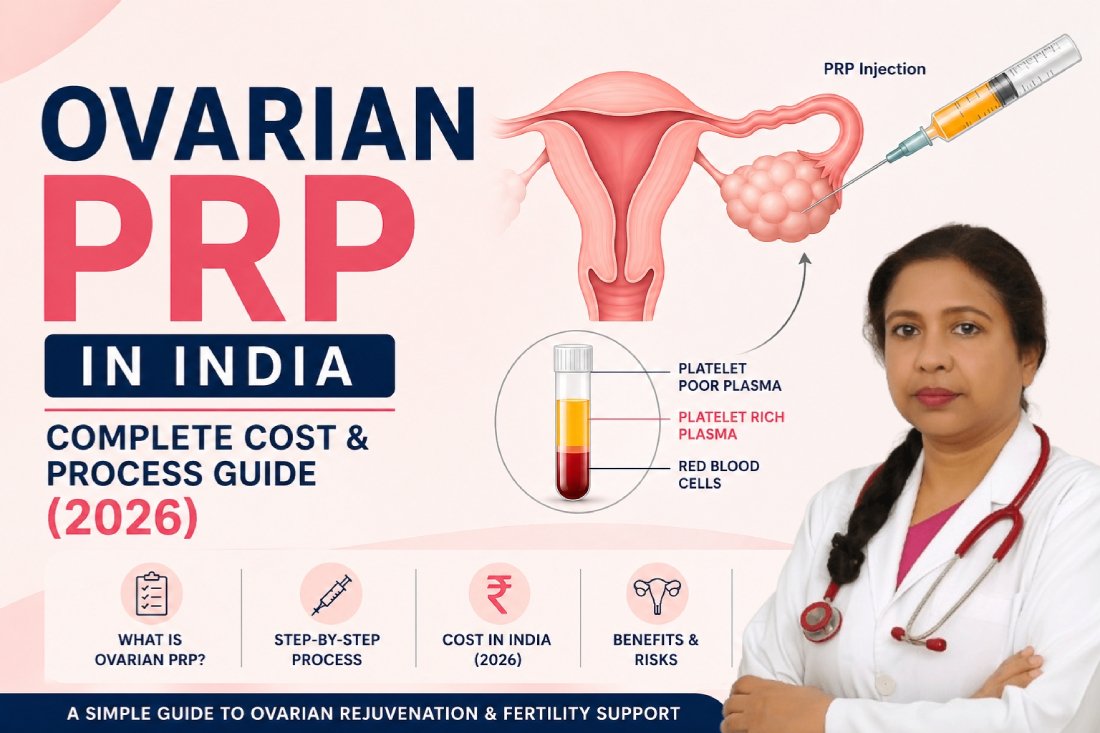
Ovarian PRP in India – Complete Guide by Dr. Nalini Gupta
Fertility treatment in India is changing fast. Many people are now hearing about PRP. Some people call it rejuvenation. Others see it as an option for women with low ovarian reserve.
The big question is. Does Ovarian PRP really help? What is the process? How much does it cost in India?
The truth about PRP is simple. It is not magic. It is not a guaranteed fertility solution.. For some women Ovarian PRP has opened another possible path. This is for women facing low AMH, poor egg quality, early menopause or repeated IVF failure, with Ovarian PRP.
What is Ovarian PRP?
Ovarian PRP is a treatment for ovaries that uses Platelet-Rich Plasma.Doctors take a bit of your blood for this treatment. They separate the part of the blood that’s rich in platelets and then they put it into your ovaries. The platelets have things in them that help fix damaged tissues and make them heal.The idea of PRP is simple: if platelets can fix damaged tissues in other parts of your body then maybe they can also help your ovaries work better.
Ovarian PRP is also known as rejuvenation because it helps make your ovaries work better, This treatment is a way to help people have babies and it is being used in many fertility centres, in India. Ovarian PRP is a way to help people who are having trouble getting pregnant.
The ovarian PRP treatment uses your blood so it is a natural way to help your ovaries.
Why Ovarian PRP Becoming Popular in India?
Ten years ago women, with ovarian reserve did not have many choices.
Usually doctors suggested:
- IVF with own eggs
- IVF with donor eggs
- Hormonal support
- Waiting and monitoring
But now PRP has become part of the conversation.
Why?
Because modern fertility treatment is shifting from “replacement” to “repair.”
That is the real reason PRP has gained attention.
Women want to improve egg quality before IVF instead of directly moving toward donor egg options.
That is a major emotional reason behind the rise of ovarian PRP.
Who Can Consider Ovarian PRP?
Not everyone needs ovarian PRP.
It is generally considered for:
1. Women with Low AMH
Low AMH means low egg reserve.
PRP may help improve ovarian response.
2. Poor IVF Responders
Some women produce very few eggs during IVF.
PRP may improve response.
3. Early Menopause
Women entering menopause early may consider it.
4. Premature Ovarian Insufficiency
The Premature Ovarian Insufficiency or the POI may see some improvement with the help of Platelet Rich Plasma. The Platelet Rich Plasma may help stimulate the follicles, in the Premature Ovarian Insufficiency or the POI.
5. Poor Egg Quality
Women with repeated poor embryo quality may discuss PRP.
But here is an honest point:
PRP is not useful when ovarian function is completely exhausted.
This is where realistic expectations matter.
How Does Ovarian PRP Work?
The science is based on growth factors.
Platelets release healing signals such as:
- VEGF
- PDGF
- TGF-beta
- IGF
These factors may improve:
- Blood supply to ovaries
- Cellular repair
- Follicle activity
- Ovarian tissue response
The theory sounds strong.
But science is still evolving.
That is important to understand.
Many fertility treatments become popular faster than the research becomes strong.
PRP is one such example.
Steps of Ovarian PRP Process in India
Understanding the process helps reduce fear.
Here is how it usually happens:
Step 1: Fertility Evaluation
Before PRP, doctors check:
- AMH
- FSH
- LH
- Estradiol
- Ultrasound
- AFC (Antral Follicle Count)
This helps understand ovarian condition.
Step 2: Blood Collection
The doctor takes 20 to 30 milliliters of blood from the patient.
This is like a normal blood test.
Step 3: PRP Preparation
The blood is processed in a centrifuge machine.
This separates:
- Red blood cells
- Plasma
- Platelets
The platelet-rich part is collected.
Step 4: Ovarian Injection
Using ultrasound guidance, PRP is injected into ovaries.
This is usually done under light sedation.
The procedure is not very invasive.
Step 5: Recovery
Most women get to go on the same day they have the procedure, The recovery, from the procedure is usually quick, Some women may feel discomfort after the procedure.
Step 6: Follow-up Call
Doctors monitor:
- Hormone levels
- Period cycle
- Follicle growth
- IVF planning
Usually the effects are checked after one to three months.
How much does Ovarian PRP cost in India for the year 2026?
The cost of this treatment depends on the clinic, the city how experience the doctor has and the technology used.
The average cost, in India is as follow:
| Treatments | Costs |
| Consultation | ₹2,500 – ₹8,500 |
| Fertility Tests | ₹5,100 – ₹15,200 |
| Single PRP Session | ₹12,100 – ₹75,100 |
| Premium PRP Session | ₹75,300 – ₹1,20,500 |
| PRP + IVF Combined | ₹1.5 lakh – ₹3 lakh |
Different fertility centres have prices, Most Indian clinics charge between ₹12,000 and ₹1,20,000 for PRP, The cost depends on how complex the procedure’s
Fertility centres in India report ovarian PRP prices, The price of PRP treatment is different, in various fertility centres It mainly depends on the complexity of the PRP.
India’s top City wise Ovarian PRP Average Costs in India
Delhi NCR
₹45,000 – ₹90,000
Mumbai
₹55,000 – ₹1,20,000
Bangalore
₹36,000 – ₹85,000
Hyderabad
₹37,000 – ₹80,000
Chennai
₹39,000 – ₹75,000
Pune
₹25,600 – ₹70,000
Metro cities usually cost more.
But higher cost does not always mean better results.
That is an important truth.
What Affects Ovarian PRP Cost?
Doctor Experience
Senior fertility specialists charge more.
Technology Used
Advanced PRP systems cost more.
Number of Sessions
Some women may need repeat sessions.
Sedation Charges
This adds extra cost.
Combined IVF Plan
PRP before IVF increases overall treatment cost.
How Successful is Ovarian PRP?
This is the most important question.
And the most misunderstood.
Some women see:
- Better AMH
- Better follicle count
- Better egg retrieval
- Better embryo quality
But not everyone sees improvement.
Research is still developing on it.
A few studies and patient experiences show that it can help. We still need more proof to say it is a standard way to treat fertility issues Some people, in the community have had results while others have not.
That means:
Hope? Yes.
Guarantee? No.
That difference matters.
Benefits of Ovarian PRP
Uses Your Own Blood
No donor tissue.
Lower rejection risk.
Day-Care Procedure
No hospital admission.
May Improve Egg Quality
Useful before IVF.
May Improve Ovarian Response
Helpful in low reserve cases.
May Delay Menopause in Some Cases
Still under study.
Risks of Ovarian PRP
Every procedure has risks.
Possible risks include:
- Mild pain
- Bleeding
- Infection
- No response
- Temporary discomfort
Biggest risk?
Emotional expectations.
Many patients expect too much.
That creates disappointment.
Ovarian PRP vs IVF: What’s the Difference?
PRP and IVF are not competitors.
They are different.
| Factor | Ovarian PRP | IVF |
| Purpose | Improve ovarian health | Pregnancy treatment |
| Procedure | Injection-based | Full fertility cycle |
| Time | 1 day | 4-6 weeks |
| Cost | Lower | Higher |
| Success Guarantee | No | No |
PRP can be done before IVF.
Think of PRP as preparation.
Not replacement.
Is Ovarian PRP Worth It?
Honest answer:
Depends.
If the ovarian reserve is low but there are still some eggs left it might be an idea to talk about PRP. The ovarian reserve is, like a bank of eggs. If it is low PRP could be something to consider. The ovarian reserve plays a role in this so it is worth thinking about what PRP can do to help with a low ovarian reserve.
If age is advanced and egg reserve is extremely low, expectations should be realistic.
Many people spend lakhs on repeated IVF cycles without improving egg quality.
Sometimes investing in ovarian health first makes more sense.
But only if the doctor feels there is biological scope.
That is the key.
Not hope.
Biology.
Questions to Ask Before Ovarian PRP
Before starting, ask:
- What is my AMH level?
- What is my AFC?
- Am I a suitable candidate?
- How many PRP cases have you handled?
- What outcomes have you seen?
- Do I need IVF after PRP?
- How many sessions might be needed?
These questions can save time and money.
Final Thoughts
Ovarian PRP in India is growing because fertility medicine is changing.
People no longer only want treatment.
They want better biological preparation.
That is where PRP fits.
But one thing should be remembered:
Fertility is deeply individual.
What works for one woman may not work for another woman. Every woman is different. What is good for one woman is not always good, for another woman. This is because each woman has her needs and her own way of doing things. So what works for one woman will not work for every woman.
PRP should not be seen as a miracle.
It should be seen as a medical option.
And like every option, it should be chosen with clear understanding, not emotional pressure.
That is the healthiest way to approach fertility treatment.
FAQ’s
1. Is ovarian PRP painful?
Usually no. Mild discomfort may happen, but sedation is often used.
2. How long does ovarian PRP take?
Usually 1-2 hours, including preparation and recovery.
3. Can ovarian PRP improve AMH?
In some cases yes, but not guaranteed.
4. How many PRP sessions are needed?
Some women need one, others may need multiple sessions depending on ovarian response.
5. Is ovarian PRP better than donor egg IVF?
Not better. Just a different option. Donor egg IVF still has stronger success rates in many cases.
