
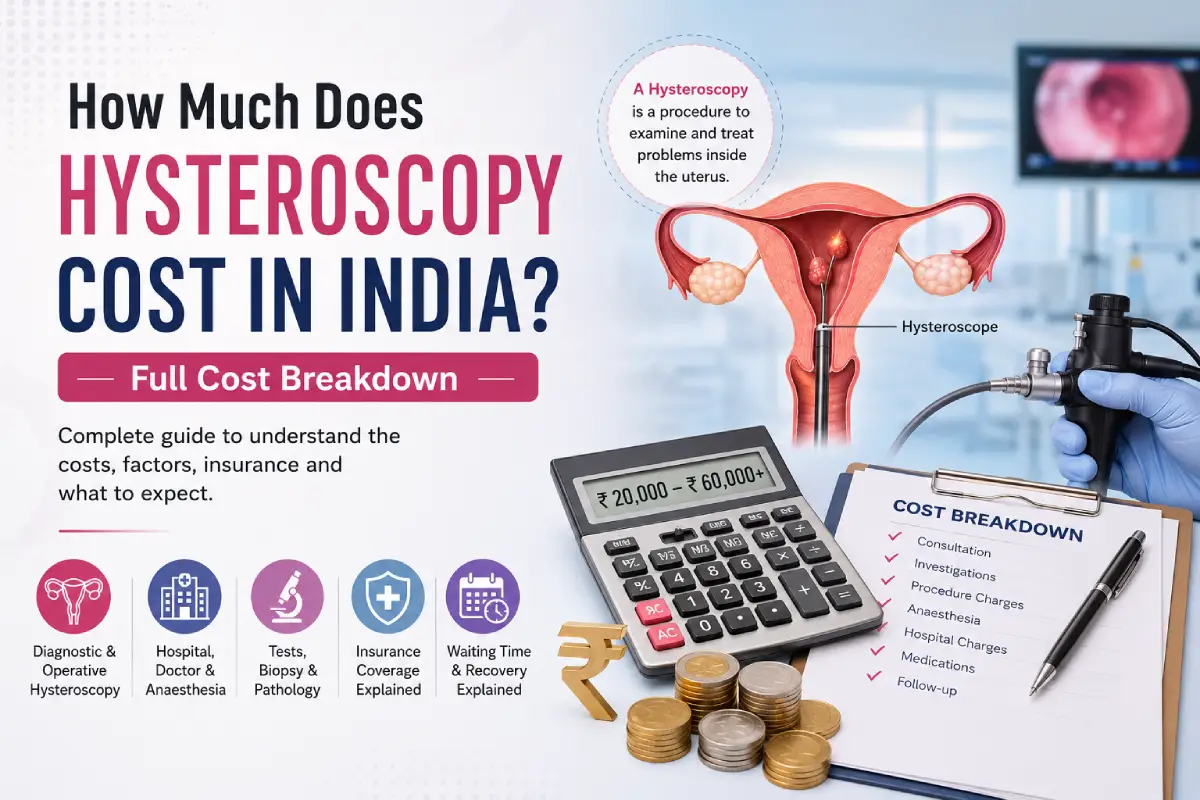

Looking for Hysteroscopy cost? Hysteroscopy is often discussed as a single procedure with a single price. In reality, that is not how patients experience the cost. The final amount can change significantly depending on one important question: is the doctor only examining the inside of the uterus, or is treatment also being performed during the procedure?
That difference separates a diagnostic hysteroscopy from an operative hysteroscopy and can substantially affect the total bill.
In India, hysteroscopy costs can range widely. A basic office-based diagnostic procedure may cost much less than a hospital-based procedure performed under anaesthesia. Similarly, removing a small uterine polyp is different from treating extensive adhesions or a submucosal fibroid.
As a practical estimate, patients in India may see costs starting from around ₹10,000 – ₹15,000 for some basic diagnostic procedures, while hospital-based diagnostic or operative hysteroscopy can range from ₹20,000 to ₹60,000 or more, depending on the complexity and hospital. Different published hospital and healthcare estimates show substantial variation, which is exactly why patients should ask for a written, itemised estimate rather than relying on one advertised figure.
This guide explains what patients are actually paying for, which costs may be separate, how insurance may apply, and what to ask before scheduling the procedure.
What Is a Hysteroscopy?
A hysteroscopy is a procedure in which a doctor examines the inside of the uterus using a thin instrument called a hysteroscope. The instrument has a camera and light, allowing the doctor to view the uterine cavity directly.
The procedure may be recommended for several reasons, including:
- Abnormal uterine bleeding
- Heavy or irregular periods
- Suspected uterine polyps
- Fibroids growing into the uterine cavity
- Uterine adhesions
- Congenital abnormalities such as a uterine septum
- Repeated miscarriage in selected cases
- Fertility evaluation when clinically indicated
- Investigation of an abnormal ultrasound finding
- Endometrial biopsy or assessment of the uterine lining
There are two broad categories.
Diagnostic hysteroscopy
The purpose is mainly to examine the uterine cavity and identify a possible problem. Depending on the setting and the patient’s condition, it may be performed in an outpatient or hospital environment.
Operative hysteroscopy
The procedure goes beyond examination. The doctor may treat a problem found inside the uterus, such as removing a polyp, cutting adhesions, correcting a septum, or removing selected submucosal fibroids.
This distinction matters because the name “hysteroscopy” alone does not tell you what the final cost will be.
A patient comparing two quotations should therefore avoid asking only, “What is the cost of hysteroscopy?” A better question is:
“Is this estimate for diagnostic hysteroscopy only, and what happens to the cost if treatment or biopsy is required during the procedure?”
That one question can prevent major confusion later.
What’s the Cost of a Hysteroscopy in India? Updated for 2026
The cost of hysteroscopy in India depends primarily on the type of procedure and where it is performed.
A broad estimate is shown below.
| Type of Hysteroscopy | Approximate Cost Range in India |
| Office/Basic Diagnostic Hysteroscopy | ₹10,000 – ₹20,000 |
| Diagnostic Hysteroscopy Under Anaesthesia | ₹15,000 – ₹30,000+ |
| Hospital-Based Diagnostic Hysteroscopy Package | ₹20,000 – ₹40,000+ |
| Operative Hysteroscopy | ₹30,000 – ₹60,000+ |
| Complex Operative Hysteroscopy | ₹60,000 – ₹1,00,000+ in some cases |
These figures should be treated as planning ranges, not fixed prices. Published estimates from hospitals and healthcare providers vary considerably depending on the hospital, city, package structure and complexity.
Why are the price ranges so wide?
Because “hysteroscopy” may include very different levels of care.
For example:
- One patient may undergo a short diagnostic procedure without anaesthesia.
- Another may require general anaesthesia.
- A third patient may have a polyp removed.
- Another may need treatment for dense uterine adhesions.
- Some patients may require a biopsy.
- Some procedures may need specialised surgical equipment.
These are not financially identical procedures.
A realistic way to look at the cost
Instead of searching for the “average hysteroscopy price,” patients should divide the bill into four parts:
- Before the procedure – consultation and investigations
- During the procedure – doctor, OT, equipment and anaesthesia
- Treatment performed during hysteroscopy – biopsy, polyp removal, adhesiolysis or other procedures
- After the procedure – medicines, pathology and follow-up
This approach gives a much more accurate picture of what the final expense may be.
What Contributes to the Average Cost of Hysteroscopy in India?
Several factors influence the final cost.
1. Diagnostic or operative procedure
This is usually the biggest factor.
A diagnostic procedure involves visual examination of the uterus. An operative hysteroscopy involves treatment as well. Removing tissue or correcting an abnormality requires additional surgical time, instruments and expertise.
2. Type of problem being treated
The cost may differ depending on whether the procedure involves:
- Polyp removal
- Endometrial biopsy
- Adhesion removal
- Septum resection
- Submucosal fibroid removal
- Treatment of more complex uterine abnormalities
A simple finding may require little additional intervention, while a complex procedure may need more operating time.
3. Hospital or clinic setting
An office procedure and an operating theatre procedure are not comparable from a cost perspective.
A hospital may include charges for:
- Operation theatre
- Nursing staff
- Recovery room
- Medical supplies
- Monitoring equipment
- Day-care admission
A larger tertiary hospital may therefore have a higher package cost than a small day-care facility.
4. Anaesthesia or sedation
Not every hysteroscopy requires the same type of anaesthesia.
Depending on the procedure and the patient’s needs, there may be:
- No anaesthesia
- Local anaesthesia
- Sedation
- General anaesthesia
Anaesthesia can add separate costs for the anaesthetist, medicines and monitoring.
5. Doctor’s professional fees
The treating doctor’s fee may be included in a package or billed separately. Senior specialists and complex procedures may involve higher professional charges.
Patients should ask clearly whether the quoted package includes:
- Gynaecologist’s fee
- Surgeon or procedural fee
- Anaesthetist’s fee
- Assistant surgeon, if applicable
6. Pre-procedure investigations
Depending on the patient’s history and planned procedure, tests may include:
- Blood tests
- Pregnancy test where appropriate
- Ultrasound
- ECG in selected patients
- Other pre-anaesthesia investigations
These are sometimes included in a package and sometimes billed separately.
7. Biopsy and pathology
If tissue is removed, the procedure itself may not be the final cost. The sample may need to be sent for histopathological examination.
This means there can be separate charges for:
- Tissue collection
- Laboratory processing
- Histopathology report
This is one of the most commonly overlooked costs.
8. City and hospital location
Hysteroscopy costs are often higher in large metropolitan private hospitals because of higher infrastructure and operating expenses.
However, a higher price does not automatically mean a better procedure. What matters more is whether the facility has the appropriate equipment, trained team and experience for the specific problem being treated.
9. Complexity discovered during the procedure
This is an important point that patients should understand in advance.
Sometimes the procedure begins as diagnostic, but an abnormality is found that can potentially be treated during the same session. Depending on prior consent and the clinical situation, the treatment plan and cost may change.
Ask the doctor beforehand:
“If you find a polyp, adhesion or another problem, will treatment be done in the same procedure, and how will the charges change?”
That is a far more useful conversation than comparing only the starting package price.
Are There Other Out-of-Pocket Costs for a Hysteroscopy?
Yes. The procedure package may not include every expense.
Possible out-of-pocket costs include:
- Initial specialist consultation
- Follow-up consultation
- Blood tests
- Ultrasound
- Pre-anaesthesia assessment
- Pregnancy testing where applicable
- Anaesthesia charges
- Medicines
- Biopsy charges
- Histopathology
- Additional surgical consumables
- Day-care or recovery charges
- Travel and accommodation for patients coming from another city
The safest approach is to request an itemised written estimate.
Before booking the procedure, ask:
- What exactly is included in the package?
- Is the doctor’s fee included?
- Is anaesthesia included?
- Are pre-procedure tests included?
- Is biopsy included?
- Are pathology charges included?
- What happens if an operative procedure is required?
- Are medicines and follow-up visits included?
A low advertised package may not always represent the final amount paid.
Are There Other Costs After a Hysteroscopy in India?
Most hysteroscopy procedures do not involve a long hospital stay, and many are performed as day-care procedures. However, patients may still have some expenses after the procedure.
Possible costs include:
Medicines
The doctor may prescribe medication depending on the type of procedure and individual recovery needs.
Follow-up consultation
Some patients require a follow-up appointment to discuss:
- Recovery
- Procedure findings
- Biopsy results
- Further treatment
Histopathology report
If a biopsy or tissue removal was performed, laboratory testing may be charged separately.
Further treatment
A hysteroscopy may identify a condition that requires additional treatment. For example, a patient may need medication, fertility treatment or further surgery depending on the diagnosis.
This is an important distinction: the cost of hysteroscopy and the cost of treating the condition found during hysteroscopy are not always the same thing.
Repeat hysteroscopy
In selected cases, a repeat procedure may be recommended, particularly when the doctor needs to reassess the uterine cavity after treatment. Whether this is necessary depends entirely on the patient’s condition.
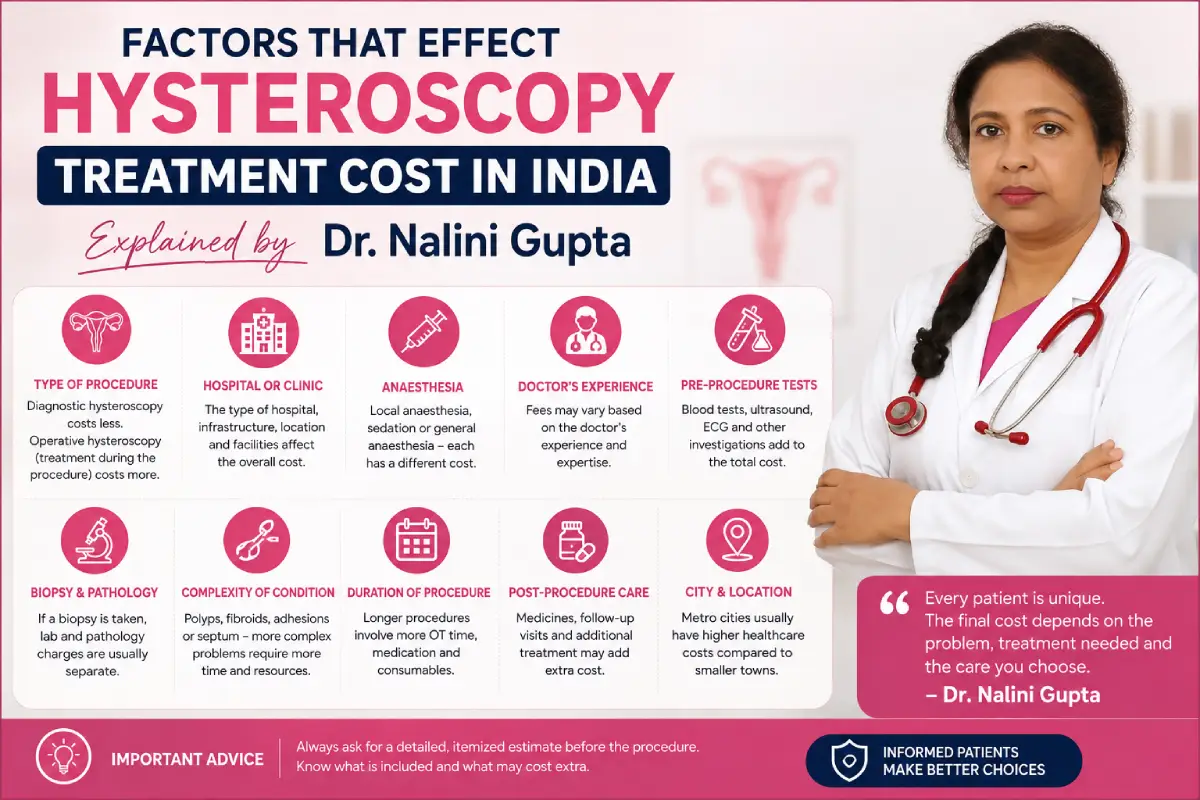
Factors Affecting Hysteroscopy Treatment Cost in India Explained by Dr. Nalini Gupta
How Long Will I Have to Wait for a Hysteroscopy Treatment in India?
There is no single waiting period across India.
In private hospitals and fertility centres, the procedure may sometimes be scheduled within a few days to a few weeks, depending on:
- Doctor availability
- Hospital schedule
- Required investigations
- The patient’s menstrual cycle
- Whether anaesthesia is needed
- The urgency of the condition
In government hospitals, waiting times can be longer because of patient volume and operating theatre availability.
For many patients, timing is also connected to the menstrual cycle. The doctor may recommend performing hysteroscopy at a particular stage depending on the reason for the procedure and whether pregnancy is possible.
For this reason, “How soon can I get the procedure?” should be discussed together with “What is the best time in my cycle?”
A fast appointment is not always the same as the medically appropriate appointment.
What Level of Health Insurance Do I Need to Cover a Hysteroscopy in India?
Insurance coverage for hysteroscopy depends on why the procedure is being performed and what your policy covers.
This is where many patients make an incorrect assumption. Having health insurance does not automatically mean every hysteroscopy-related expense will be covered.
Coverage may depend on:
- Whether the procedure is medically necessary
- Whether it is diagnostic or operative
- The underlying diagnosis
- Hospital network eligibility
- Day-care procedure coverage
- Waiting periods
- Pre-existing condition clauses
- Policy exclusions
- Maternity or fertility treatment exclusions
If hysteroscopy is medically necessary
A policy with appropriate hospitalisation or day-care coverage may cover the procedure, subject to the policy terms and approval process.
If the procedure is part of fertility treatment
Coverage can be more complicated. Many insurance policies in India have limitations or exclusions related to infertility evaluation and treatment.
Patients should not assume that because hysteroscopy is a recognised medical procedure, it will automatically be covered when performed as part of a fertility treatment plan.
What to check with the insurer
Before scheduling the procedure, ask your insurance provider:
- Is hysteroscopy covered under my policy?
- Is diagnostic hysteroscopy covered?
- Is operative hysteroscopy covered?
- Is day-care treatment covered?
- Does my hospital fall within the cashless network?
- Is pre-authorisation required?
- Are pre-procedure tests covered?
- Is biopsy and pathology covered?
- Are there any exclusions related to infertility treatment?
- Is there a waiting period?
If possible, get the coverage confirmation in writing.
For eligible government beneficiaries, applicable scheme rates may also provide a useful reference point. For example, published CGHS rate information lists different rates based on city and hospital category for certain hysteroscopy-related procedures.
The Most Important Thing to Remember About Hysteroscopy Cost
The most useful way to understand hysteroscopy pricing is this:
Do not compare hospitals using only one headline number. Compare what the number includes.
A ₹20,000 estimate and a ₹40,000 estimate may actually be difficult to compare if one includes:
- Consultation
- Pre-operative tests
- Anaesthesia
- Operation theatre
- Doctor’s fee
- Recovery room
while the other includes only the procedure fee.
The best estimate is not necessarily the lowest one. It is the estimate that clearly explains:
- What procedure is planned
- Who will perform it
- Where it will be performed
- What type of anaesthesia is planned
- What is included
- What may cost extra
- What happens if additional treatment is required
That level of clarity is more valuable than a headline discount or a vague package price.
Frequently Asked Questions About Hysteroscopy Cost in India
1. What is the average cost of hysteroscopy in India?
The cost can vary widely. Basic diagnostic hysteroscopy may start from around ₹10,000–₹20,000 in some settings, while hospital-based diagnostic or operative procedures can range from ₹20,000 to ₹60,000 or more. The final amount depends mainly on whether the procedure is diagnostic or operative, the hospital, anaesthesia and any additional treatment.
2. Is diagnostic hysteroscopy cheaper than operative hysteroscopy?
Generally, yes. Diagnostic hysteroscopy is mainly used to examine the uterine cavity, while operative hysteroscopy involves treatment such as removing a polyp, adhesions or another abnormality. The additional surgical work, equipment and procedure time can increase the cost.
3. Does the hysteroscopy package include biopsy and pathology?
Not always. A biopsy may involve separate procedural and laboratory charges. Always ask whether tissue collection, histopathology and the final report are included in the estimate.
4. Is hysteroscopy covered by health insurance in India?
It may be covered when medically indicated, but coverage depends on the specific insurance policy and the reason for the procedure. Fertility-related treatment may have exclusions or limitations. Confirm diagnostic, operative and day-care coverage with the insurer before treatment.
5. Can the cost increase after hysteroscopy starts?
In some situations, yes. If the procedure identifies a problem requiring treatment, such as a polyp or adhesion, the treatment plan may change. Patients should discuss in advance whether additional procedures can be performed during the same session and what the additional charges may be.
Final Thoughts
Hysteroscopy is not one fixed-price procedure. The final cost depends on the purpose of the procedure, the type of facility, anaesthesia, tests, treatment performed and whether additional findings need to be addressed.
For most patients, the smartest approach is simple: understand the exact procedure being planned before comparing prices.
Ask for a written estimate, check what is included, clarify possible additional charges and verify insurance coverage before admission. This gives a much clearer picture of the actual financial commitment and helps avoid unexpected bills later.
Because every patient’s medical situation is different, the final decision about whether hysteroscopy is needed, when it should be performed and what type is appropriate should be made with a qualified gynaecologist.
