
Embryo transfer is one of the shortest steps in IVF, but it is one of the most misunderstood when families discuss money. Many people are told one number for the “transfer”, and later they see separate charges for medicines, scans, freezing, thawing, storage, and blood tests. That is where confusion starts.
The clinical truth is simple: the embryo transfer cost is not just the cost of putting the embryo inside the uterus. The real expense is in the preparation before transfer and the support after it.
Embryo transfer cost in India (Detailed 2026)
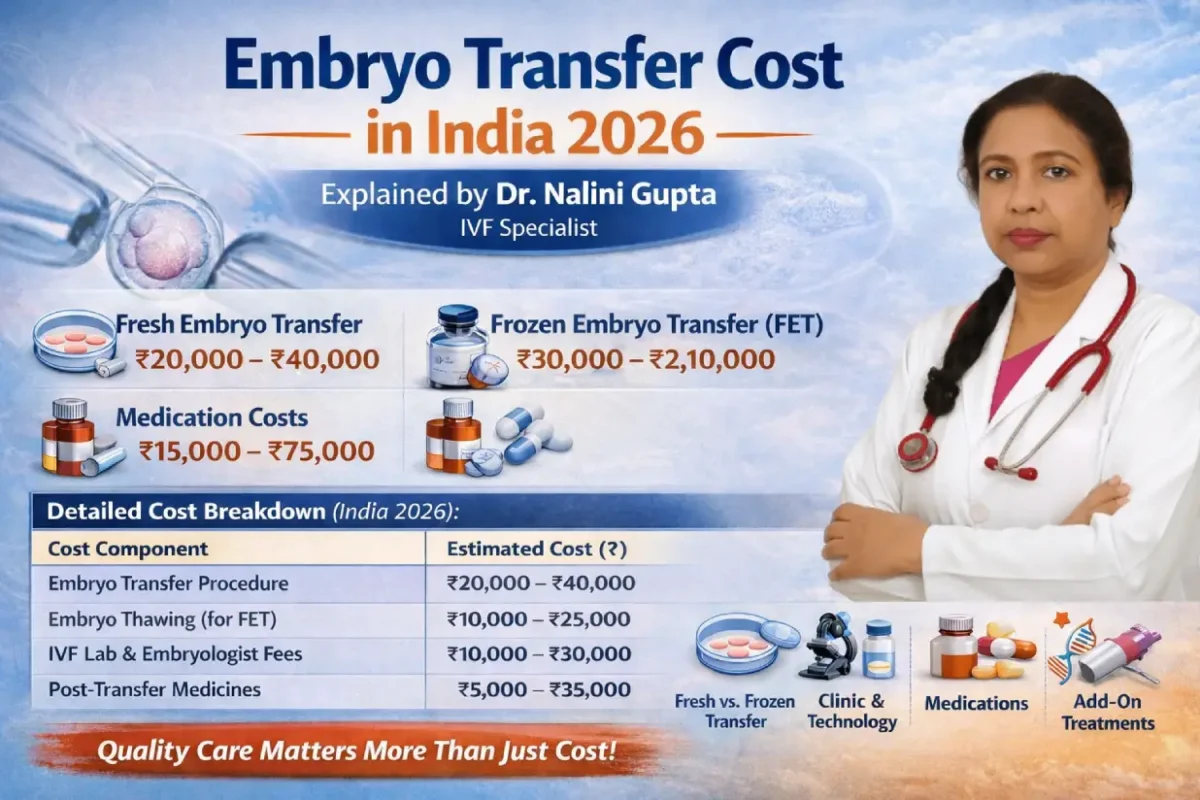
- Embryo transfer cost in India for a fresh transfer can be around ₹25,000 to ₹50,000 if billed separately.
- In many IVF centres, fresh embryo transfer is already included in the IVF package, so patients may not see a separate line item.
- Frozen Embryo transfer cost in India usually ranges from ₹45,000 to ₹95,000.
- If freezing charges and yearly storage are added, the total can go up to ₹1,10,000 or more.
These are practical 2026 estimate ranges for standard private fertility centres in India. Premium hospitals, complex cases, donor cycles, and optional add-ons can increase the bill.
What is embryo transfer?
Embryo transfer is the step where the embryo is placed inside the uterus using a thin catheter. It is usually a short and painless procedure. It may be done in two ways:
1. Fresh embryo transfer
The embryo is transferred in the same IVF cycle, a few days after egg retrieval.
2. Frozen embryo transfer (FET)
The embryo is frozen first and transferred in a later cycle after preparing the uterine lining properly.
A very important point: the Frozen Embryo transfer cost is not the same as embryo freezing cost. These are different charges, and many families mix them up.
Embryo transfer cost components in India 2026
The best way to understand cost is to break it into parts.
| Embryo transfer component | Fresh embryo transfer cost | Frozen embryo transfer cost | What it means |
| Consultation and cycle planning | ₹1,000 – ₹3,000 | ₹1,000 – ₹3,000 | Review of reports, timing, treatment plan |
| Medicines for uterine lining preparation | Often included or minimal | ₹5,000 – ₹20,000 | Tablets, injections, hormonal support |
| Ultrasound scans and blood tests | ₹3,000 – ₹8,000 | ₹5,000 – ₹15,000 | Monitoring lining and ovulation/hormones |
| Embryo transfer procedure fee | ₹15,000 – ₹30,000 | ₹15,000 – ₹35,000 | Main procedure charge |
| Procedure room / consumables / catheter | ₹2,000 – ₹5,000 | ₹2,000 – ₹6,000 | Catheter, sterile items, support materials |
| Embryology lab handling | Usually part of IVF cycle | ₹10,000 – ₹25,000 | Thawing and preparing frozen embryo |
| Luteal support medicines after transfer | ₹3,000 – ₹10,000 | ₹3,000 – ₹12,000 | Progesterone and related medicines |
| Pregnancy test and early follow-up | ₹1,500 – ₹4,000 | ₹1,500 – ₹4,000 | Beta hCG and first review |
| Embryo freezing charge | Usually part of IVF cycle | ₹10,000 – ₹25,000 if charged separately | Paid earlier when embryos are frozen |
| Embryo storage fee | Not usually relevant | ₹5,000 – ₹15,000 per year | Yearly storage in cryobank |
Estimated total
- Embryo transfer cost (fresh, if billed separately): ₹25,000 – ₹50,000
- Frozen Embryo transfer cost: ₹45,000 – ₹95,000
- Frozen Embryo transfer cost in India with storage or old freezing charges added: ₹50,000 – ₹1,10,000+
Embryo transfer cost in top cities of India for 2026
City matters. Rent, lab cost, hospital overhead, and specialist fees change the final number. But city alone does not decide quality.
| City | Embryo transfer cost (fresh, if billed separately) | Frozen Embryo transfer cost in India |
| Delhi NCR | ₹30,000 – ₹55,000 | ₹50,000 – ₹95,000 |
| Mumbai | ₹35,000 – ₹60,000 | ₹55,000 – ₹1,00,000 |
| Bengaluru | ₹30,000 – ₹55,000 | ₹50,000 – ₹90,000 |
| Chennai | ₹28,000 – ₹50,000 | ₹45,000 – ₹85,000 |
| Hyderabad | ₹28,000 – ₹50,000 | ₹45,000 – ₹85,000 |
| Pune | ₹28,000 – ₹48,000 | ₹45,000 – ₹80,000 |
| Ahmedabad | ₹25,000 – ₹45,000 | ₹40,000 – ₹75,000 |
| Kolkata | ₹25,000 – ₹45,000 | ₹42,000 – ₹78,000 |
Important note: These are broad 2026 private-centre estimates. Government hospitals and teaching institutions may charge less, but access, waiting period, and case selection can differ.
Why Frozen Embryo transfer cost is often misunderstood
This is where most billing confusion happens.
A patient may ask for Frozen Embryo transfer cost in India, but the final bill may include three separate things:
- Old embryo freezing charge from the previous IVF cycle
- Yearly storage charge for keeping embryos frozen
- Current FET cycle charge for medicines, scans, thawing, and transfer
These three are not the same. When centres combine them without clear explanation, the family feels the transfer itself is expensive. In reality, part of that amount may belong to a previous cycle.
Strong clinical view:
A transparent fertility centre should clearly separate:
- transfer procedure cost,
- thawing/lab cost,
- medicine cost,
- storage cost,
- optional add-ons.
If this breakdown is not given, the quote is incomplete.
What increases embryo transfer cost?
1. Fresh vs frozen transfer
A fresh transfer is usually cheaper only if it is already included in the IVF cycle.
A frozen transfer often has extra cost because of:
- uterine lining preparation,
- thawing,
- extra scans,
- storage charges.
2. Natural cycle FET vs medicated FET
Some women go through a natural cycle FET, where the body ovulates naturally. This may reduce medicine cost but needs close monitoring.
A medicated FET may use more hormonal support and can increase cost.
3. Embryo stage
Blastocyst embryos, day-3 embryos, assisted hatching, and special lab handling may change cost.
4. City and centre type
Metro city hospitals usually charge more. But a higher fee does not automatically mean better pregnancy rates.
5. Add-ons
Some centres add:
- embryo glue,
- assisted hatching,
- extra monitoring,
- advanced blood tests.
These are not needed for every patient. They should not be pushed as routine.
6. Cancellation and rescheduling
If the uterine lining is not ready, progesterone rises too early, or the body is not responding well, the transfer may be postponed. That means more scans, more medicines, and sometimes more cost.
A doctor’s view: the cheapest quote is often not the cheapest treatment
This is an important point.
Many families search only for the lowest Embryo transfer cost. But in fertility care, a low quote can hide missing items. A ₹35,000 quote may become ₹70,000 after adding scans, medicines, thawing, catheter, and follow-up.
A better question is:
“What exactly is included in this embryo transfer cost in India?”
That one question prevents most billing surprises.
Ask for these details in writing:
- Is the transfer included in the IVF package or separate?
- Are medicines included?
- How many scans are included?
- Is embryo thawing included in the FET cost?
- Is storage charged separately?
- Are add-ons optional or routine?
- If the cycle is cancelled, what amount is refundable?
This is not bargaining. This is informed medical consent.
Does a higher embryo transfer cost mean higher success?
No.
Success depends more on:
- woman’s age,
- embryo quality,
- uterine lining quality,
- embryo genetics,
- lab standards,
- proper timing,
- transfer technique,
- hormone support after transfer.
The transfer procedure itself may take only a few minutes. The biology behind that procedure matters far more than the length of the procedure.
That is why a very expensive transfer with poor embryo quality may fail, while a simpler cycle with a good embryo and well-prepared uterus may succeed.
Practical cost summary for 2026
Fresh embryo transfer
- Usually part of IVF package
- If billed separately: ₹25,000 – ₹50,000
Frozen embryo transfer
- Standard FET cycle: ₹45,000 – ₹95,000
- If freezing and storage are also added: ₹50,000 – ₹1,10,000+
Most common mistake
Families confuse:
- embryo transfer fee,
- embryo freezing fee,
- embryo storage fee.
These should always be shown separately.
FAQs on Embryo Transfer Cost in India
1. Is embryo transfer cost separate from IVF cost?
Often, fresh embryo transfer is included in the IVF package. But some centres bill parts separately, especially medicines, scans, catheter, and blood tests. Always ask for item-wise costing.
2. What is the Frozen Embryo transfer cost in India in 2026?
A standard Frozen Embryo transfer cost in India is usually around ₹45,000 to ₹95,000. If yearly storage or previous freezing charges are added, the total can go higher.
3. Why is Frozen Embryo transfer cost sometimes higher than fresh embryo transfer?
Because FET may include:
- uterine lining preparation,
- repeat scans,
- embryo thawing,
- extra lab work,
- storage-related charges.
The transfer itself is short, but the preparation is what changes the bill.
4. Are add-ons like embryo glue always necessary?
No. Add-ons are not necessary for every patient. They should be advised only when there is a clear medical reason. Routine use without explanation is not good practice.
5. How can a patient avoid hidden charges in embryo transfer?
Ask for a written estimate with:
- medicines,
- scans,
- lab charges,
- thawing,
- storage,
- procedure fee,
- pregnancy test,
- refund or cancellation policy.
A clear bill is a sign of ethical care.