
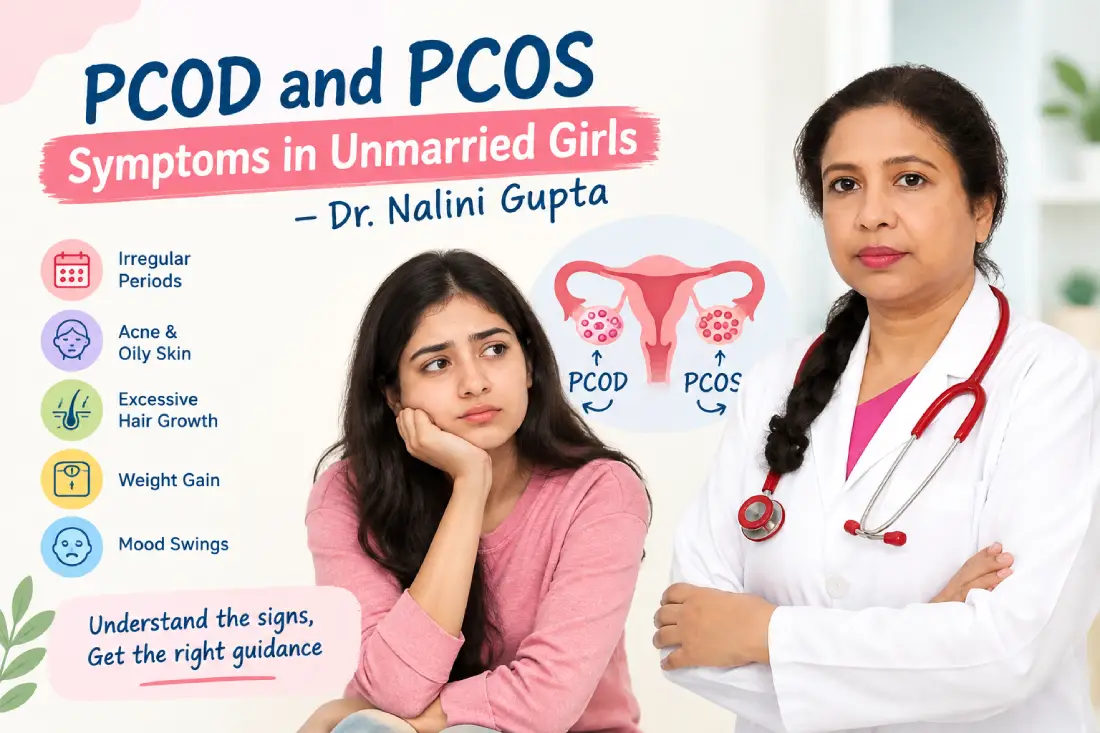

Have your periods gone irregular? Are you getting more pimples than before, noticing extra hair on your face, or putting on weight without knowing why? If so, you might be wondering if it’s PCOD or PCOS.
A lot of young girls in India deal with these problems but don’t talk to their parents or a doctor about them. Some feel shy. Others are scared of what the symptoms might mean for their future.
First, you should know that PCOD and PCOS don’t only happen to married women. Teenagers and unmarried girls can have them too. You don’t have to be married or sexually active to have a hormonal problem or to see a doctor about it.
Also, don’t panic. Not every irregular period means PCOS. Your hormones change a lot during the teenage years, and the same symptom can have different causes.
In this article, Dr. Nalini Gupta explains the common signs, how doctors check for PCOD and PCOS, and what a young girl can do to look after her health.
What Are PCOD and PCOS?
PCOS stands for Polycystic Ovary Syndrome. PCOD stands for Polycystic Ovarian Disease. Most people use the two words to mean the same thing, but PCOS is the proper medical term. It is a hormonal condition that can affect your periods, ovulation, skin, hair and metabolism.
In PCOS, the body may make more androgens than usual. Androgens are hormones that every person has. The ovaries may also not release an egg regularly. Some women with PCOS have ovaries with many small follicles, but this isn’t true for everyone.
Having many small follicles on an ultrasound doesn’t automatically mean you have PCOS.
PCOS is a hormonal condition. It says nothing about a girl’s character, habits or marital status.
Common PCOD Symptoms in Unmarried Girls
Symptoms differ from girl to girl. Some first notice changes in their periods. Others notice acne, extra hair, or trouble with weight.
1. Irregular Periods
This is one of the most common signs of a hormonal problem. You may notice:
- Periods coming much earlier or later than expected
- Long gaps between two periods
- No period for several months
- Fewer periods in a year than usual
- A change in your usual cycle
In the first few years after your first period, some irregularity is normal. But if the gaps are long and keep repeating, or if your regular periods suddenly become irregular, don’t ignore it.
For example, if you normally get your period every month and then go several months without one, see a gynaecologist instead of waiting it out.
A missed period doesn’t automatically mean PCOS. Stress, thyroid problems, big changes in weight, too much exercise and other hormonal conditions can also affect your periods.
2. Acne and Oily Skin
Pimples are common in the teenage years, but some girls keep getting bad acne well into their twenties. You may notice:
- Repeated pimples on the chin and jawline
- Oily skin even after you wash your face regularly
- Deep, painful pimples
- Acne that gets better for a while and then comes back
- Breakouts along with irregular periods or more facial hair
Hormones can make your skin produce more oil, which leads to acne.
But acne alone isn’t enough to say someone has PCOS. Plenty of girls without any hormonal condition get pimples, especially during puberty. If your acne is severe, painful or leaving scars, a dermatologist can suggest the right treatment.
3. Unwanted Facial and Body Hair
Some girls see thick, dark hair on the chin, upper lip, chest, lower abdomen or other places where hair is usually fine. This is called hirsutism, and it can sometimes be linked to higher androgen levels.
Look at how your body is changing over time. Don’t compare yourself with friends or people on social media, because normal hair growth is different for everyone.
If you see coarse hair along with irregular periods or constant acne, talk to a doctor. A few facial hairs on their own don’t mean you have PCOS, and there’s nothing to be ashamed of.
4. Weight Gain or Trouble Controlling Weight
Some girls with PCOS slowly gain weight, mostly around the waist. Others find it hard to lose weight even after changing their routine.
PCOS can be linked to insulin resistance, which means the body doesn’t respond to insulin properly. This can cause metabolic changes in some people.
But PCOS isn’t only for girls who are overweight. Girls with a healthy weight can have it too. And weight gain can come from less activity, poor sleep, stress, certain medicines or other health problems.
It’s not fair to blame a girl for her symptoms or to say that losing weight will fix everything. A doctor should look at her age, symptoms and medical history together.
5. Hair Thinning or Hair Fall
Your scalp hair may get thinner, especially on top of the head or along the parting. You may also see more hair falling when you comb or wash it.
Hair loss has many causes, such as low iron, thyroid problems, poor nutrition, stress and hormonal changes. Don’t assume it’s PCOS. If the thinning keeps going or comes with other hormonal symptoms, get it checked.
6. Dark Patches on the Neck or Underarms
Some girls get darker, thicker, velvety skin on the neck, underarms or other skin folds. This is called acanthosis nigricans. It can be linked to insulin resistance, though there are other possible causes.
This is different from a tan or normal pigmentation. If you notice a new skin change, especially along with irregular periods or weight changes, see a doctor. Don’t scrub the area hard or use strong whitening products.
7. Mood Changes and Stress
Hormonal problems don’t only affect the body. A girl may feel worried about how she looks, upset about unpredictable periods, or embarrassed about acne and facial hair. Some women with PCOS also have anxiety, low mood or body image problems.
These feelings matter. Don’t brush them off as overthinking or “teenage drama.” At the same time, mood changes alone can’t tell you whether you have a hormonal disorder. Poor sleep, family pressure and studies can affect your mood too.
Talking to a trusted adult or a doctor can make it easier to get help.
Can an Unmarried Girl Have PCOS?
Yes. PCOS can affect teenagers, unmarried girls and adult women. Marriage has nothing to do with whether you develop it.
The confusion comes from the fact that PCOS is mostly talked about in connection with fertility. In reality, it can start around adolescence, when changes in periods, skin and hair first show up.
An unmarried girl may notice:
- Periods that stay irregular after the first few years
- Acne that doesn’t go away, along with other hormonal signs
- More coarse hair on the face or body
- Thinning scalp hair
- Weight changes or signs of insulin resistance
Not everyone gets all of these. Some girls have only one or two, and others have several.
Symptoms can make a doctor suspect PCOS, but they can’t confirm it alone. The doctor will look at your age, period history, physical signs and, if needed, test results. In teenagers, diagnosis needs extra care because normal puberty can look a lot like PCOS.
When Should You See a Doctor?
Many girls wait for months because they think irregular periods are normal at their age. Others feel awkward talking about reproductive health. It helps to know which changes need attention.
Book an appointment if:
- You’ve missed three periods in a row
- Your periods are very irregular or have changed a lot
- You’ve gone about 90 days without a period, especially if it’s more than a year since your first one
- Your acne is severe or won’t go away, and you have other hormonal symptoms
- Coarse facial hair is increasing, or your scalp hair is thinning a lot
- Your weight has changed for no clear reason, or you have new dark, velvety patches
See a doctor quickly if you notice sudden, marked facial hair growth, a deepening voice or other signs of very high androgens.
Get urgent medical help for very heavy bleeding with dizziness or fainting, or for sudden, severe pain in the abdomen or pelvis.
Don’t wait for every symptom to show up before asking for advice.
How Is PCOS Diagnosed?
No single symptom or blood test confirms PCOS in everyone. The doctor looks at your age, medical history and symptoms.
1. Period history. The doctor will ask when your first period came, how often you get your period, and whether your cycle has changed. It helps to note down your period dates. You can also write down changes in acne, hair, weight and any medicines you take.
2. Physical check-up. Depending on your symptoms, the doctor may look at your acne, hair growth, hair thinning and blood pressure. An internal examination isn’t automatically needed just because an unmarried girl is being checked for PCOS. Any examination should match your symptoms and be explained to you first.
3. Blood tests. The doctor may order tests to check hormone levels or rule out other conditions. These can include testosterone, thyroid function and prolactin. Blood sugar and cholesterol tests may also be done to check metabolic health. Not every girl needs every test. It depends on the individual case.
4. Ultrasound, only if needed. An ultrasound can help in some cases, but it isn’t required to diagnose PCOS in every unmarried girl. In teenagers, the way the ovaries look can be a normal part of puberty. Current international guidelines advise against using an ovarian ultrasound alone to diagnose PCOS in adolescents.
The aim is to avoid unnecessary tests while making sure ongoing symptoms get proper attention.
Can PCOS Be Treated?
Yes. Treatment depends on your symptoms, age, medical history and health goals. Being unmarried doesn’t stop you from getting proper care. Treatment should focus on your health now, not on assumptions about marriage or pregnancy.
Lifestyle changes. Regular exercise, enough sleep and balanced meals help your overall and metabolic health. A simple routine could include:
- Regular, balanced meals with vegetables, fruits, pulses, whole grains and good sources of protein
- Some kind of movement you enjoy, like walking, cycling, dancing or sports
- A fixed sleep schedule
- No crash diets or extreme workouts
- Help for stress and emotional wellbeing if you need it
No single diet cures PCOS. A routine you can stick to works better than strict food rules or expensive supplements. Lifestyle changes help, but they don’t replace a medical check-up when your symptoms need treatment.
Medicines for irregular periods. Depending on the cause, a doctor may prescribe hormonal medicines to regulate your periods or protect the lining of the uterus. The right medicine depends on your medical history and treatment goals. Never start these on a friend’s advice or by yourself.
Treatment for acne and extra hair. Persistent acne can be treated with skin medicines. Options for unwanted hair depend on how severe it is, the cause, and what you prefer. Some hormonal treatments suit certain patients. Some medicines can harm a developing pregnancy, so you need a doctor’s guidance even if you’re not planning one.
Long-term follow-up. Some girls need regular checks of blood sugar, cholesterol or other markers. How often depends on your risk factors. Treatment isn’t only about clearer skin or regular periods. It’s also about protecting your health and catching related problems early.
Will PCOS Make It Hard to Get Pregnant Later?
Not necessarily. A PCOS diagnosis doesn’t mean you will definitely have trouble getting pregnant.
PCOS can interfere with regular ovulation, which can make conceiving harder for some women. But symptoms and their severity vary a lot, and many women with PCOS get pregnant naturally. Others need some medical help.
You also can’t predict fertility from acne, weight or an ultrasound report alone.
For an unmarried girl, the main goal right now is to understand her period and hormone health. There’s no need to turn a present health concern into a prediction about the future. Getting checked early helps you understand the condition and manage it well.
Five Common Myths About PCOD and PCOS
Myth 1: Only married women get PCOS.
Fact: PCOS can start in the teenage years and affect unmarried girls.
Myth 2: Every irregular period means PCOS.
Fact: Irregular periods have many possible causes. Your age, the pattern and your other symptoms all matter.
Myth 3: Only overweight girls get PCOS.
Fact: PCOS can affect people of all body sizes.
Myth 4: Many follicles on an ultrasound confirm PCOS.
Fact: An ultrasound alone isn’t enough, especially in teenagers.
Myth 5: PCOS always causes infertility.
Fact: PCOS can affect ovulation, but it doesn’t mean pregnancy is impossible.
